Wednesday, April 20, 2011

The Power of Parents


This weekend I attended the All Born (In) Cross-Disability Inclusion Conference in Portland. I teach general education teacher about inclusion and inclusion strategies, so I was excited to attend my first official inclusion conference. Many different professionals organized the conference, but parents of children or adult with disabilities played a huge role in putting it all together.

When I walked into the main room after signing in, my hope that this conference would be a bit out of the ordinary was confirmed. First of all, kids were everywhere. There were bands of little guys with Downs Syndrome, family members taking turns holding babies, and teenagers and young adults selling their artwork. I knew we were off to a great start!

Our morning keynote speaker was Kathie Snow. I use her Person First Language materials in my inclusion and exceptional child courses, so I was excited to meet her in person. She gave a dynamic speech about disability being natural and addressed how unnatural and harmful exclusion and segregation is for people with disabilities. Read more at www.disabilityisnatural.com I had a student last term who was originally resistant to person first language and asked, “Who is this Kathie Snow person anyhow? What makes her so credible?” I explained that Kathie is a parent of adult children with disabilities who became a disability advocate and educator (plus so much more!). Needless to say my student quickly accepted Kathie Snow as a credible source.

All three keynote speakers were parents of a child with a disability.

My first session called “Inclusion: Is there an app for that?” was co-lead by two professionals, two parents and a 6-year-old girl with Downs Syndrome. I watched transfixed as the little blonde haired girl demonstrated a variety of educational applications on her iPad. I was equally intrigued watching the mom work with and speak to the little girl as I was viewing the different apps! It seemed like most of the large audience was comprised of supportive parents. Communication and visual schedule tools were also modeled. I’ll be writing a separate blog on these apps.

The session before lunch was perhaps the most inspiring. The session was lead by young adult with disabilities. All of them were selling their artwork during the conference, and this was their time to explain their work and voice their opinions. They were proud of their accomplishments and had plenty to say about inclusion! One young man, Dylan Kuehl presented a motivational speech that brought me to tears. He also shared information about his business, DK Arts, Visual and Performing Arts Co. He’s a dancer, painter, practices Kung Fu, writes poetry, etc. He’s a handsome young fellow who travels the world and raises hope for people with disabilities.

Later in the afternoon I was sitting at a table with a group of teens (maybe young adults?) while Dylan was on stage performing. A young gal told me that she thought Dylan was cute and wanted him for a boyfriend. I agreed that he’d be quite a catch! Dylan’s mother was beautifully supportive of him and his work throughout the day, and it was a joy to see their close relationship. Please support Dylan by visiting his website http://www.oly-wa.us/dkarts/index.php

In an afternoon session about co-teaching models I had the honor of meeting a parent who wants her child’s school to have a more inclusive model of education for students with exceptionalities. I told her about my success story with implementing various inclusive co-teaching models at the elementary level and we exchanged information so that I can consult with the school if they need a hand.

We discuss the importance of parental involvement in the schools and the connection between the school, family and community. But how many teachers have the opportunity to see what these parents are really made of? This weekend, strong parents who know their children inside and out and will go to extreme measures to help their child succeed surrounded me. They’re active. They’re engaged. They want to collaborate with professionals. They have a voice that needs to be heard more than once a year at the annual IEP meeting. Their skills and passions can be utilized for more than PTA bake sales.

I encourage my student teacher to get parents involved in the classroom. Letters are sent home to communicate about the curriculum. Parents may be invited to see their child present their final performance task. But I think teachers need additional ideas for getting parents involved. Sometimes the teacher must win the trust of parents before they’ll collaborate. Some effective strategies that I’ve used are home visits and calls home to tell mom and dad that their child had a great day or made progress towards a goal. For a writing project, I had students bring family photographs to school, scanned them into the computer, and the students create movies about their lives. When the parents came to view this work, I provided food and time to mingle with each other hoping that they would eventually create a support network. I interviewed parents about their family for a graduate school project. I offered to provide childcare on the weekends and evenings to parents who were desperate for respite care. I started every single IEP meeting by sharing student success stories. These are a few examples, and I know there are zillions of additional ideas that teachers successfully use.

Once again, is there anyone out there who will share a story or strategy for meaningful parental involvement? By sharing your idea, you could help shape future educators!!!

Monday, April 11, 2011

Technology: Where is it leading us?


I have an interesting relationship with technology. I don't like to pay a lot of money for it or be too dependent on it. I worry that the kid love affair with technology is keeping our youth from experiencing some of life’s simplest pleasures: discovering a wild patch of blackberries, walking down the railroad tracks, swimming in the hot sun all day and then having the best sleep of your life. You know, the good stuff.

But technology is fun. And it’s exciting. It’s making my life more connected to the people I love and care about. And I'm managing my life more easily.

You can play cool games, including ones that make you play with language and solve puzzles. I like Words With Friends, Wordoid and Crossword. I play scrabble with my former Penn State women’s studies advisor/teacher/friend. What a fun way to reconnect with the people who mean so much to us!

You can discover new music with SoundHound when you’re out dancing or watching a movie, and then instantly stream it in Rhapsody. You can save songs and entire albums to a playlist that you’ll later listen to in your car or while grading papers at a coffee shop.

Information is more accessible than ever and I’m an info-junkie. I love learning. I’m having so much fun using new apps and assessing their professional and personal benefits. These are a few that I’m trying out:

Google Sky to study the constellations
Mint to manage finances
Dictionary
Flixster for local show times, movie trailers, reviews
MagLite Led Torch for when you need a flashlight
Appolicious to find new cool apps 
NPR to keep up on the news
Skyfire as my browser
AllRecipes for meal ideas
Blogger to keep up to date with this endeavor!
EverNote for reminders and lists, two things I can’t live without
Gmail & YouTube
Netflix Queue to add films when people make suggestions

I’m sure that our brains are changing due to the way we are constantly receiving information in fast, small, often disconnected bytes. I want to know more about how the brain is changing or could change if we don’t temper this “shallow” information bombardment with something else. Like reading novels, taking long quiet walks in the woods, camping for a weekend with nothing more technologically complex than a campfire. 

What do you think?  How do you balance your life? Are there forms of technology that you're avoiding? What are you loving?

Thursday, March 31, 2011

Something in the water...

Ahhhhhhhhhhhh...Spring Term is finally here.

With every SOU corner I turn, I see smiling faces and hear laughter. All of the trees are budding, the birds are repairing their nests, spring flowers are everywhere. It's so refreshing.

I have a new hop in my step too. I FINALLY upgraded to a smartphone (a Droid Pro) and I'm having the time of my life trying to figure it out, working with new apps, listening to new music, etc. I have to give credit to my dear, dear friend Mike Taylor for inspiring me and coaching me on this upgrade :)

I also have slightly lighter teaching load and my students have already completed a work sample which means they are more confident this term. There are many reasons to rejoice!

On that note, I'm going for a walk in the sunshine before class. Get out of your office and enjoy the spring! If you're a teacher, bring those kids outside for goodness sakes!

Blessings to you all :)

Tuesday, March 15, 2011

Tweeting in Blogger- Oh my!

This is going to be a tweet-sized blog!

Three blogs ago I talked about focusing my blog on strategies/philosophies that work in a K-12 setting and in the graduate school settings. Then I made a mistake- I created a list. Now I feel obligated to follow that list; I feel like each blog I create that's not on my list is a broken agreement with you all. So I'm writing to free myself of these fetters I've created! I may get to the list, I may not! As your friend, I will conclude by saying that I don't recommend making lists when it comes to creative endeavors. Make your lists at work or make a grocery list. But lay off when it comes to your art. Give yourself that much freedom!

Collective Wisdom


While teaching in New Mexico, my young students taught me about collective wisdom. My students had exceptionalities and were therefore considered by many to be lacking in intelligence and a general “brightness.” But as my time with these children unfolded I could see them shining as brightly as anyone else who wants to be loved and is eager to learn. Why was I able to see their light? High expectations? Attitude? Was it because they were in an environment where they could peel back their protective layers and allow themselves to grow? 

I remember the last words my Pap said to me before he died. He said,
“Angela, don’t you ever hide your light under a bushel.”

Well I was a performer back then (the summer of 1999, I believe) and had been for the previous six years. I just assumed he was telling me to keep on singing. But as years pass by I realize that he wasn’t talking about singing at all. He was talking about life. He was telling me that I had a brightness that deserved to shine. So maybe, more likely, I was primed by my Pap to look for this brightness in other people. I certainly like to think that my grandfather helped me to develop that gift.

Needless to say, I could easily see all of the greatness that was in my resource room. And I’d talk about my students’ gifts and talents in the teacher lounge: “Does anyone realize that Vickie* has a fever for justice?” and “I think Emison* is one of the wisest people I’ve ever met” and “Andy* has the most pure heart I’ve ever witnessed.” I was also displaying their amazing work in the halls and boasting about their rising reading levels. I was trying to help other adults see the brightness of these kids. Or I was inviting them to at least be open to the notion that kids with IEPs can shine too. It worked on some teachers, but not on others.(*I've changed names- you know who you are!)

As a teacher educator, I get to see the brightness in my student teachers as well. Of course it’s a pleasure to get to know their personalities; but they are enduring one of the most stressful years of their lives and I am aware that I’m not exactly seeing their usual selves. I’m often helping them with crises, using core reflection to help them see their strengths, guiding them through projects…

But there is a magical thing that occurs with my adult students. They are learning how to be teachers. I’m a teacher. I am teaching them about teaching. They are teaching almost everyday. We’re all studying about teaching. 

We have a teaching culture. 

And something amazing is born out of this culture. At some point, most of the student teachers begin thinking like teachers. And if the professor has sprinkled enough fairy dust into the classroom culture, they begin to realize that ultimately we are all colleagues.  And here comes the magic…I watch them become teachers right before my little eyes.

So acting as my teacher colleagues, my students begin to tell me how I can improve my teaching practice just like I’ve been advising them all term. To me, this is the cherry on top! I crave constructive feedback and guidance from other teachers just like I crave French fries or adventure or the smell of my dog's fur.

In a final project reflection paper this term, a student suggested a smart way for me to improve the project. His suggestion was driven by his desire for the project to be more authentic. I think that he has truly learned that the best learning comes from authentic experiences and that’s why he took the time to discuss it with me. But what exactly made him comfortable doing it? Is he showing that he cares about the learners who will come after him? Does he see me as colleague? Does he trust that I'm not going to take it personally, but take it as an opportunity to be better teacher? 

To wrap this up, I love that my students offer great suggestions and ideas every term. I have implemented these ideas with great success, and I always attribute the change from whence it came. There’s something special about saying, “This assignment was create by last year’s cohort specifically for you; it’s a gift from those who came before you so that you’ll be a better teacher.” Most students are receptive and even eager for the opportunity. That's inspiring.

I want to end with a question- a shout out to anyone out there who may be reading. Tell me, what have you learned from a student? How did it change you or your practice? What were the circumstances that made this exchange possible? Was there a magical ingredient? If you think there was- what was it?!

Saturday, March 12, 2011

Praise & Gratitude: The End of Another Term


Just like the cycle of the seasons, summer fall winter spring, each term seems to turn with great speed. Here we are, the end of finals week of the winter term, with stacks of papers and piles of work samples to be reviewed before the brief freedom of spring break can set in.

I want to take a minute to pause and give thanks. I’m grateful for all of the learning that occurred this term. I feel lucky to have met and worked with inspiring, bright student teachers. Each day, in the expectant faces of my students, I feel encouraged to be the best possible teacher I can be.

I’m grateful that at the end of the term my students take the time to thank me for my hard work and ensure that my efforts have paid off.  Of course it feels good to hear that my students learned an incredible amount of content knowledge in my courses, but nothing quite beats hearing them tell me that I’ve modeled what it means to be a great teacher. That statement just warms my heart to no end. Honestly, I’m so focused on the ways I want to improve my teaching practice that I often neglect to celebrate my successes. I will look back at these comments when I need a boost of encouragement. So…thanks

But perhaps most of all, I feel the need to praise the loved ones that surround me each day. I wake up in the morning and I know I’m loved. I sit down to dinner and I know I’m love. I go to bed and I know I’m loved. I’m blessed with a supportive, caring, understanding family. This factor has been the unsung hero of my career in higher education. I feel blessed beyond words.

So, as I reengage in the grading process I will go forth with gratitude in my heart. Enjoy this quote by Melody Beattle:

“Gratitude unlocks the fullness of life. It turns what we have into enough, and more. It turns denial into acceptance, chaos into order, confusion into clarity. It can turn a meal into a feast, a house into a home, a stranger into a friend. Gratitude makes sense of our past, brings peace for today, and creates a future for tomorrow.”

Monday, February 14, 2011

A Focus for this Blog: Effective Strategies for Reaching the Adult Learner

I’ve decided on a focus for my blog after a term and a half of contemplation and piecemeal blogging. Since I began teaching at the university level, I’ve been completing an informal research study exploring how to best teach adult learners. I know best practices of teaching children, and I’ve spent years studying if these same strategies are effective with adult learners. My findings at the point indicate that YES! these practices are effective with adult learners but require a few adjustments. In future blogs I will address some of these techniques, including but not limited to:
·         Offering student choice & providing opportunities for self directed learning
·         Creating a classroom climate conducive to learning
·         Providing ample opportunities to provided feedback to the instructor
·         Modeling
·         Providing “think time”
·         Providing highly engaging lessons
·         Focusing instruction with the big picture in mind
·         Providing ample feedback on student performance
·         Focusing on students’ strengths
·         Being available and involved
Some of these topics will most likely be addressed in a series of posts. I appreciate the opportunity to model what it looks like to be a reflective practitioner, to celebrate successes and learn from mistakes, and to generate new ideas that inspire better teaching and learning for the future.
I also want to say that blogging about my work in a public forum is very intimidating and it often leaves me feeling vulnerable, exposed, and uncertain. There are many times when I deliberate what I feel safe discussing and what information I keep to myself. I suppose this is a typical professional behavior. Considering that we are putting our students to situations that evoke these same kinds of emotions, I’m taking this as an opportunity to further relate to my students. I so desperately want to connect to my students, just as I want our student teachers to connect to their students. I suppose this is just more modeling of professional teaching behaviors. Until next time- Cheers!

Wednesday, January 26, 2011

Winter, Work Samples & Woe

There’s a reason I haven’t posted a new blog in a while. It’s winter term which means we have 10 solid weeks of teaching without any breaks. Also, students are completing their first work samples and are often frustrated, confused, and totally stressed out. Many students are falling ill. Professors and student teachers look a little bit frazzled and are more prone to having a short temper. In a nutshell, we could use a little more sunshine outside and inside of our building!
Despite this situation, how do we stay fresh? How do we keep balance in our lives? I’m feeling like a work horse: work, sleep, work, sleep… and I know our students are feeling it too. After conducting some informal research online, I’ve found some stress reduction techniques that are suggested for teachers.
One technique is to work smart. Keep your materials organized so you can more efficiently use your time. Last weekend I came to work on a Sunday and reorganized my entire office. It felt amazing, and now I can walk in and get right down to work.
Another technique is to be conscious of our thinking process. We can easily let our thinking spiral in a negative direction. Acknowledge the negative thinking, do some deep breathing, and allow yourself to be open to a more positive message. Also, avoid spending time with people who complain and worry. Seek out peers who are enthusiastic and are able to enjoy their teaching despite the workload.
The last technique that I’ll share is to take a minute or so each day to marvel at something beautiful. Maybe you see an older couple holding hands and laughing- that’s a beautiful sight! Maybe you take pleasure in seeing the kids play on the playground- volunteer for recess duty! In the winter, I like to admire the bare “bones” of the landscape. It’s worth taking a look. It’s also really easy to bird watch in the winter. I have been seeing hawks everyday! Beauty is all around us and it feels refreshing to look.
My own piece of advice for our students is to understand that your first work sample is much more challenging than the next one. You’re getting your feet wet and learning so much through the process. Be gentle and kind to yourself right now. You’ll reap the benefits of this hard work next term and for the rest of your career as a teacher!

Thursday, December 9, 2010

Fall Finals and An Undefined Longing

As fall term comes to a close, there is a definite buzz in the air. Students and teachers alike are exhausted yet excited for the freedom of winter break. It’s easy to get distracted at this time of the year and therefore forget that we are meeting with our students for the final time. Much energy was put into creating a classroom community for each course, and there is sadness for me when we disband. I may never see some of these students again even though I will remember them and think of them often. I wonder if professors have figured out a good way to keep in touch with students over the years. If you have ideas, please post a comment. I’m just dying for someone to post a comment!
When each course ends I let my students know that I will continue to be a resource for them as they begin teaching, but they rarely seize the opportunity. I am lucky to be friends with a few former students who are doing great things in the community, but I still think about the others. Where are they? Are they happy with teaching? Are their families well? ARE YOU OUT THERE?
The other day I passed a student on the street. We stopped to chat, but there was awkwardness to the conversation. I realized that teachers are limited in their ability to truly know their students. We can’t really socialize with our students during the term, but when the term is over the relationship is usually over too. It’s a strange conundrum that I haven’t quite figured out yet. Perhaps I need to be satisfied with the teacher-student relationships and accept that it naturally dissipate as time moves on. But still, I wonder if it could be different…
There is no cheerleading in this message, just a longing that is still undefined. I just can’t help feeling a little bit down as I say good-bye to my students. My holiday wish this year is that all of my students and colleagues feel loved, safe, and fulfilled now and always. Much love to you all!

Wednesday, November 17, 2010

The Courageous Seek Student Feedback

Throughout the last two years of university teaching, I have left the classroom desiring more input from students regarding which activities were the most impactful, what they are thinking and what they still want to learn. I’ve always invited the students to verbalize these tidbits at the end of class, but I found this practice to be pretty ineffective. At the same time, I’ve struggled with saving enough time at the end of class for a proper closure. I would ask probing questions to see where the students are in their understanding of the daily topic, but I wanted something more.

Upon reflection, I decided to implement an old technique used by my very first mentor, Brian Jara from Penn State University. When I was his teaching assistant for Women’s Studies classes, he handed out little scraps of paper to each student at the end of class.  They would take a few minutes to reflect on what they learned in class, how they were feeling about the topic, share how they personally connected to the material, and offer feedback to class presenters. As we collected these reflections, we could also make personal contact with each individual: “Great job on that paper!” “Have a wonderful weekend,” and “Come visit me during office hours so we can brainstorm some ideas for your final project.”

I’m not sure why it took two years for me to implement this technique, but I’ve started using it this year as a way to gather anonymous, meaningful feedback and as a final closure piece.  I love gathering the little papers from each student at the door, making sure to use their individual names as we say our good-byes. This often prompts them to have informal conversations with me or to ask questions. When I retreat to my office after class, I don’t need to make guesses about how the students responded to the activities; I simply read their short reflections. I know what they enjoyed and why; I know what they still want to learn; I know if I am on track and guiding their learning in the right direction. I leave work with peace of mind. No more guessing games! No more agonizing over whether or not the students are “getting it!”  It’s an empowering process that I highly encourage, and it only takes about 5 minutes of class time.

I am saving all of these mini reflections. I know this is a resource I can use if I am ever feeling like an ineffective teacher or wondering if I am following the correct career path. My students encourage me, cheer me on, and let me know that they enjoy coming to my classes. They are making countless connections to their personal lives. Most of all, they appreciate the time I am putting into planning engaging lessons that feed their spirits. It feels good to know and it allows me to move on confidently.

I think this practice takes courage because it makes teachers vulnerable to possible criticism. Also, if the teaching practices implemented aren’t working, the teacher may have to adapt to the students’ needs. If teachers collect this information but don’t act upon it, does it mean they are unresponsive to students’ needs? Are they unwilling to change? Does it mean they don’t care? Are they taking advantage of their power? If instructors take the traditional route of only collecting student feedback via course evaluations at the end of the term, they are essentially off the hook. They are no longer responsible to those students. Needless to say, it’s also too late to make the course better for that batch of students. Opportunities for deeper, more meaningful learning are gone. Poof.


So I say BE COURAGEOUS. Give the students their money’s worth and then some. Make them want to come back for more!

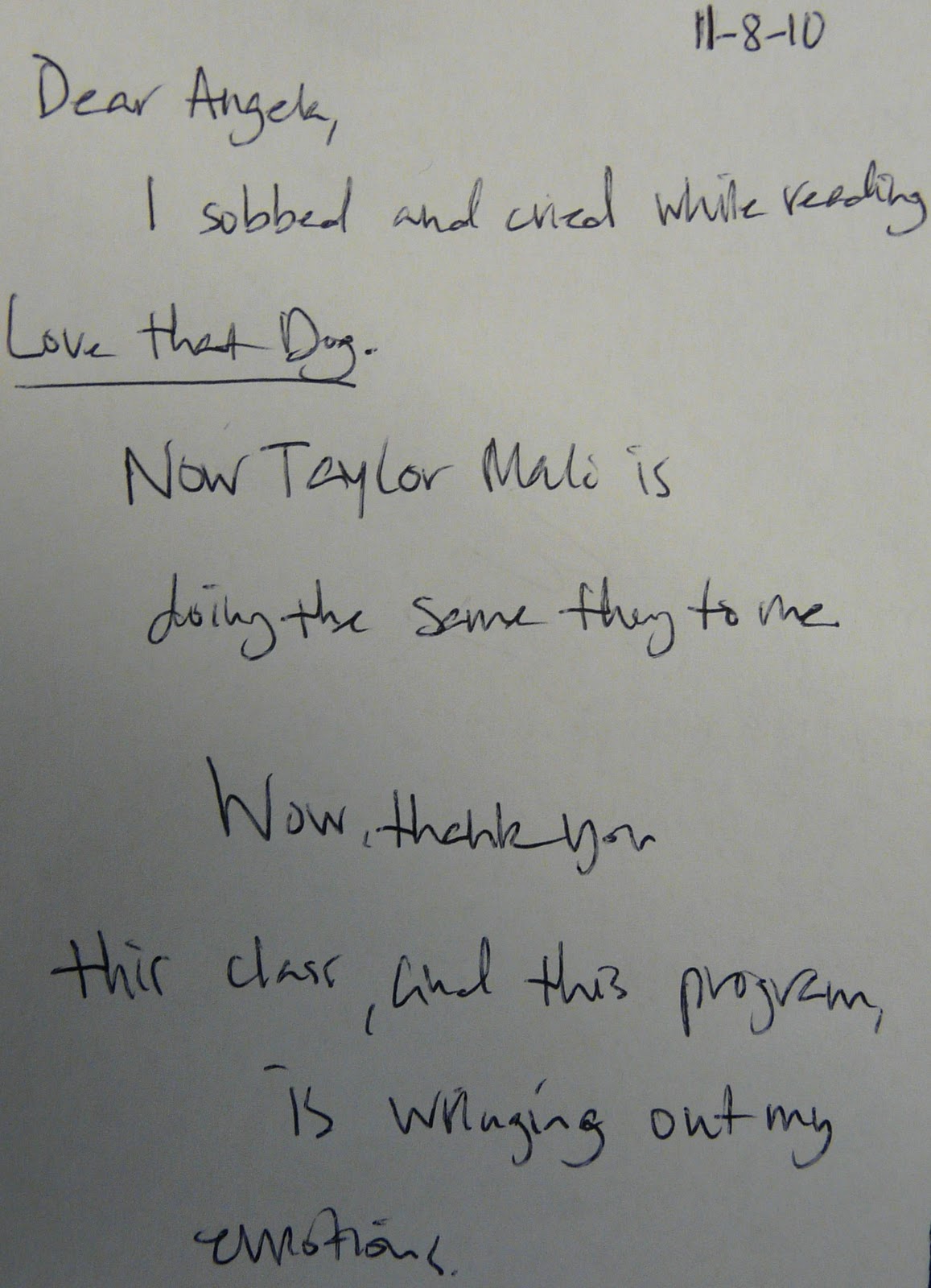
I've included a few examples of student feedback I've received this term. You can click on each one to enlarge it, thus making reading easier. While reading through 14 piles of student feedback, I did not specifically seek positive responses. I'm pleased to say that the feedback is overwhelmingly positive, with an occasional request for me to share additional information on a topic. Also, there were two class sessions that were apparently packed with too much information. My inner critic won't allow me to automatically assume that all of the students are pleased with every class. I am considering how to refine this practice further. If you have ideas, please share by posting a comment!