Tuesday, March 15, 2011

Collective Wisdom


While teaching in New Mexico, my young students taught me about collective wisdom. My students had exceptionalities and were therefore considered by many to be lacking in intelligence and a general “brightness.” But as my time with these children unfolded I could see them shining as brightly as anyone else who wants to be loved and is eager to learn. Why was I able to see their light? High expectations? Attitude? Was it because they were in an environment where they could peel back their protective layers and allow themselves to grow? 

I remember the last words my Pap said to me before he died. He said,
“Angela, don’t you ever hide your light under a bushel.”

Well I was a performer back then (the summer of 1999, I believe) and had been for the previous six years. I just assumed he was telling me to keep on singing. But as years pass by I realize that he wasn’t talking about singing at all. He was talking about life. He was telling me that I had a brightness that deserved to shine. So maybe, more likely, I was primed by my Pap to look for this brightness in other people. I certainly like to think that my grandfather helped me to develop that gift.

Needless to say, I could easily see all of the greatness that was in my resource room. And I’d talk about my students’ gifts and talents in the teacher lounge: “Does anyone realize that Vickie* has a fever for justice?” and “I think Emison* is one of the wisest people I’ve ever met” and “Andy* has the most pure heart I’ve ever witnessed.” I was also displaying their amazing work in the halls and boasting about their rising reading levels. I was trying to help other adults see the brightness of these kids. Or I was inviting them to at least be open to the notion that kids with IEPs can shine too. It worked on some teachers, but not on others.(*I've changed names- you know who you are!)

As a teacher educator, I get to see the brightness in my student teachers as well. Of course it’s a pleasure to get to know their personalities; but they are enduring one of the most stressful years of their lives and I am aware that I’m not exactly seeing their usual selves. I’m often helping them with crises, using core reflection to help them see their strengths, guiding them through projects…

But there is a magical thing that occurs with my adult students. They are learning how to be teachers. I’m a teacher. I am teaching them about teaching. They are teaching almost everyday. We’re all studying about teaching. 

We have a teaching culture. 

And something amazing is born out of this culture. At some point, most of the student teachers begin thinking like teachers. And if the professor has sprinkled enough fairy dust into the classroom culture, they begin to realize that ultimately we are all colleagues.  And here comes the magic…I watch them become teachers right before my little eyes.

So acting as my teacher colleagues, my students begin to tell me how I can improve my teaching practice just like I’ve been advising them all term. To me, this is the cherry on top! I crave constructive feedback and guidance from other teachers just like I crave French fries or adventure or the smell of my dog's fur.

In a final project reflection paper this term, a student suggested a smart way for me to improve the project. His suggestion was driven by his desire for the project to be more authentic. I think that he has truly learned that the best learning comes from authentic experiences and that’s why he took the time to discuss it with me. But what exactly made him comfortable doing it? Is he showing that he cares about the learners who will come after him? Does he see me as colleague? Does he trust that I'm not going to take it personally, but take it as an opportunity to be better teacher? 

To wrap this up, I love that my students offer great suggestions and ideas every term. I have implemented these ideas with great success, and I always attribute the change from whence it came. There’s something special about saying, “This assignment was create by last year’s cohort specifically for you; it’s a gift from those who came before you so that you’ll be a better teacher.” Most students are receptive and even eager for the opportunity. That's inspiring.

I want to end with a question- a shout out to anyone out there who may be reading. Tell me, what have you learned from a student? How did it change you or your practice? What were the circumstances that made this exchange possible? Was there a magical ingredient? If you think there was- what was it?!

Saturday, March 12, 2011

Praise & Gratitude: The End of Another Term


Just like the cycle of the seasons, summer fall winter spring, each term seems to turn with great speed. Here we are, the end of finals week of the winter term, with stacks of papers and piles of work samples to be reviewed before the brief freedom of spring break can set in.

I want to take a minute to pause and give thanks. I’m grateful for all of the learning that occurred this term. I feel lucky to have met and worked with inspiring, bright student teachers. Each day, in the expectant faces of my students, I feel encouraged to be the best possible teacher I can be.

I’m grateful that at the end of the term my students take the time to thank me for my hard work and ensure that my efforts have paid off.  Of course it feels good to hear that my students learned an incredible amount of content knowledge in my courses, but nothing quite beats hearing them tell me that I’ve modeled what it means to be a great teacher. That statement just warms my heart to no end. Honestly, I’m so focused on the ways I want to improve my teaching practice that I often neglect to celebrate my successes. I will look back at these comments when I need a boost of encouragement. So…thanks

But perhaps most of all, I feel the need to praise the loved ones that surround me each day. I wake up in the morning and I know I’m loved. I sit down to dinner and I know I’m love. I go to bed and I know I’m loved. I’m blessed with a supportive, caring, understanding family. This factor has been the unsung hero of my career in higher education. I feel blessed beyond words.

So, as I reengage in the grading process I will go forth with gratitude in my heart. Enjoy this quote by Melody Beattle:

“Gratitude unlocks the fullness of life. It turns what we have into enough, and more. It turns denial into acceptance, chaos into order, confusion into clarity. It can turn a meal into a feast, a house into a home, a stranger into a friend. Gratitude makes sense of our past, brings peace for today, and creates a future for tomorrow.”

Monday, February 14, 2011

A Focus for this Blog: Effective Strategies for Reaching the Adult Learner

I’ve decided on a focus for my blog after a term and a half of contemplation and piecemeal blogging. Since I began teaching at the university level, I’ve been completing an informal research study exploring how to best teach adult learners. I know best practices of teaching children, and I’ve spent years studying if these same strategies are effective with adult learners. My findings at the point indicate that YES! these practices are effective with adult learners but require a few adjustments. In future blogs I will address some of these techniques, including but not limited to:
·         Offering student choice & providing opportunities for self directed learning
·         Creating a classroom climate conducive to learning
·         Providing ample opportunities to provided feedback to the instructor
·         Modeling
·         Providing “think time”
·         Providing highly engaging lessons
·         Focusing instruction with the big picture in mind
·         Providing ample feedback on student performance
·         Focusing on students’ strengths
·         Being available and involved
Some of these topics will most likely be addressed in a series of posts. I appreciate the opportunity to model what it looks like to be a reflective practitioner, to celebrate successes and learn from mistakes, and to generate new ideas that inspire better teaching and learning for the future.
I also want to say that blogging about my work in a public forum is very intimidating and it often leaves me feeling vulnerable, exposed, and uncertain. There are many times when I deliberate what I feel safe discussing and what information I keep to myself. I suppose this is a typical professional behavior. Considering that we are putting our students to situations that evoke these same kinds of emotions, I’m taking this as an opportunity to further relate to my students. I so desperately want to connect to my students, just as I want our student teachers to connect to their students. I suppose this is just more modeling of professional teaching behaviors. Until next time- Cheers!

Wednesday, January 26, 2011

Winter, Work Samples & Woe

There’s a reason I haven’t posted a new blog in a while. It’s winter term which means we have 10 solid weeks of teaching without any breaks. Also, students are completing their first work samples and are often frustrated, confused, and totally stressed out. Many students are falling ill. Professors and student teachers look a little bit frazzled and are more prone to having a short temper. In a nutshell, we could use a little more sunshine outside and inside of our building!
Despite this situation, how do we stay fresh? How do we keep balance in our lives? I’m feeling like a work horse: work, sleep, work, sleep… and I know our students are feeling it too. After conducting some informal research online, I’ve found some stress reduction techniques that are suggested for teachers.
One technique is to work smart. Keep your materials organized so you can more efficiently use your time. Last weekend I came to work on a Sunday and reorganized my entire office. It felt amazing, and now I can walk in and get right down to work.
Another technique is to be conscious of our thinking process. We can easily let our thinking spiral in a negative direction. Acknowledge the negative thinking, do some deep breathing, and allow yourself to be open to a more positive message. Also, avoid spending time with people who complain and worry. Seek out peers who are enthusiastic and are able to enjoy their teaching despite the workload.
The last technique that I’ll share is to take a minute or so each day to marvel at something beautiful. Maybe you see an older couple holding hands and laughing- that’s a beautiful sight! Maybe you take pleasure in seeing the kids play on the playground- volunteer for recess duty! In the winter, I like to admire the bare “bones” of the landscape. It’s worth taking a look. It’s also really easy to bird watch in the winter. I have been seeing hawks everyday! Beauty is all around us and it feels refreshing to look.
My own piece of advice for our students is to understand that your first work sample is much more challenging than the next one. You’re getting your feet wet and learning so much through the process. Be gentle and kind to yourself right now. You’ll reap the benefits of this hard work next term and for the rest of your career as a teacher!

Thursday, December 9, 2010

Fall Finals and An Undefined Longing

As fall term comes to a close, there is a definite buzz in the air. Students and teachers alike are exhausted yet excited for the freedom of winter break. It’s easy to get distracted at this time of the year and therefore forget that we are meeting with our students for the final time. Much energy was put into creating a classroom community for each course, and there is sadness for me when we disband. I may never see some of these students again even though I will remember them and think of them often. I wonder if professors have figured out a good way to keep in touch with students over the years. If you have ideas, please post a comment. I’m just dying for someone to post a comment!
When each course ends I let my students know that I will continue to be a resource for them as they begin teaching, but they rarely seize the opportunity. I am lucky to be friends with a few former students who are doing great things in the community, but I still think about the others. Where are they? Are they happy with teaching? Are their families well? ARE YOU OUT THERE?
The other day I passed a student on the street. We stopped to chat, but there was awkwardness to the conversation. I realized that teachers are limited in their ability to truly know their students. We can’t really socialize with our students during the term, but when the term is over the relationship is usually over too. It’s a strange conundrum that I haven’t quite figured out yet. Perhaps I need to be satisfied with the teacher-student relationships and accept that it naturally dissipate as time moves on. But still, I wonder if it could be different…
There is no cheerleading in this message, just a longing that is still undefined. I just can’t help feeling a little bit down as I say good-bye to my students. My holiday wish this year is that all of my students and colleagues feel loved, safe, and fulfilled now and always. Much love to you all!

Wednesday, November 17, 2010

The Courageous Seek Student Feedback

Throughout the last two years of university teaching, I have left the classroom desiring more input from students regarding which activities were the most impactful, what they are thinking and what they still want to learn. I’ve always invited the students to verbalize these tidbits at the end of class, but I found this practice to be pretty ineffective. At the same time, I’ve struggled with saving enough time at the end of class for a proper closure. I would ask probing questions to see where the students are in their understanding of the daily topic, but I wanted something more.

Upon reflection, I decided to implement an old technique used by my very first mentor, Brian Jara from Penn State University. When I was his teaching assistant for Women’s Studies classes, he handed out little scraps of paper to each student at the end of class.  They would take a few minutes to reflect on what they learned in class, how they were feeling about the topic, share how they personally connected to the material, and offer feedback to class presenters. As we collected these reflections, we could also make personal contact with each individual: “Great job on that paper!” “Have a wonderful weekend,” and “Come visit me during office hours so we can brainstorm some ideas for your final project.”

I’m not sure why it took two years for me to implement this technique, but I’ve started using it this year as a way to gather anonymous, meaningful feedback and as a final closure piece.  I love gathering the little papers from each student at the door, making sure to use their individual names as we say our good-byes. This often prompts them to have informal conversations with me or to ask questions. When I retreat to my office after class, I don’t need to make guesses about how the students responded to the activities; I simply read their short reflections. I know what they enjoyed and why; I know what they still want to learn; I know if I am on track and guiding their learning in the right direction. I leave work with peace of mind. No more guessing games! No more agonizing over whether or not the students are “getting it!”  It’s an empowering process that I highly encourage, and it only takes about 5 minutes of class time.

I am saving all of these mini reflections. I know this is a resource I can use if I am ever feeling like an ineffective teacher or wondering if I am following the correct career path. My students encourage me, cheer me on, and let me know that they enjoy coming to my classes. They are making countless connections to their personal lives. Most of all, they appreciate the time I am putting into planning engaging lessons that feed their spirits. It feels good to know and it allows me to move on confidently.

I think this practice takes courage because it makes teachers vulnerable to possible criticism. Also, if the teaching practices implemented aren’t working, the teacher may have to adapt to the students’ needs. If teachers collect this information but don’t act upon it, does it mean they are unresponsive to students’ needs? Are they unwilling to change? Does it mean they don’t care? Are they taking advantage of their power? If instructors take the traditional route of only collecting student feedback via course evaluations at the end of the term, they are essentially off the hook. They are no longer responsible to those students. Needless to say, it’s also too late to make the course better for that batch of students. Opportunities for deeper, more meaningful learning are gone. Poof.


So I say BE COURAGEOUS. Give the students their money’s worth and then some. Make them want to come back for more!

I've included a few examples of student feedback I've received this term. You can click on each one to enlarge it, thus making reading easier. While reading through 14 piles of student feedback, I did not specifically seek positive responses. I'm pleased to say that the feedback is overwhelmingly positive, with an occasional request for me to share additional information on a topic. Also, there were two class sessions that were apparently packed with too much information. My inner critic won't allow me to automatically assume that all of the students are pleased with every class. I am considering how to refine this practice further. If you have ideas, please share by posting a comment!

Saturday, November 6, 2010

The Classroom As A Gathering of Spirit: Part 1


I walk into a university classroom with an understanding that there is a huge amount of collective wisdom in the room. Each learner will at some time be the teacher. As an elementary teacher, my students regularly humbled me with their life experiences and knowledge.  Everyday I stood before some of the most marginalized people in America (Native American children of low socioeconomic status with exceptionalities) and it always seemed that a balance was struck between the information I was teaching them and the information they were teaching me. Multiple times a week my students moved me to tears and opened a new window in my soul. They helped me glimpse truth.


And now that I am teaching at the university level I find that I am still moved to tears multiple times a week. If you can take some time to float outside of your body as you are in a classroom and just observe the learning environment, you’ll easily see that it’s a gathering of spirit.

A gathering of SPIRIT.

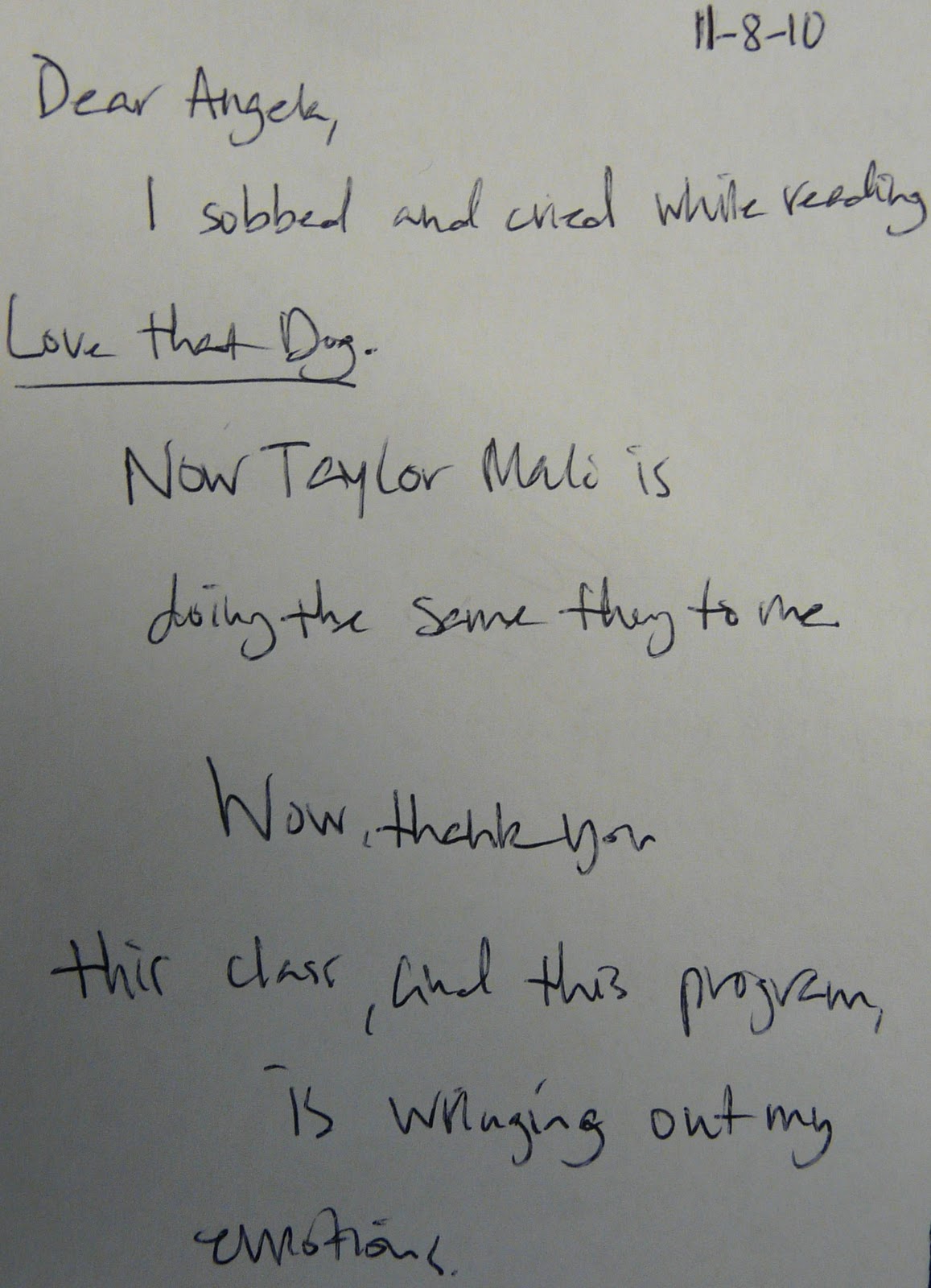
Student posts a thank you letter to a peer at the Message Center in my Language & Literacy course.
If a classroom is viewed this way, the “teacher” can’t help but understand the fragility of the situation. The attitude of the “teacher” becomes the most important determinant of whether or not the learning environment will be fruitful, stagnant or even detrimental. We lead our students by example. If it wasn’t so devastating, I may find it comical when teachers say that their classes would be more fruitful if the student’s attitude improved.

Students use Bag-A-Story materials to collaboratively write an original story. At each literacy center, the students take notes in journals about how the activities could be effectively implemented in their elementary and middle school classrooms.
In K-12 schooling, the students are required to attend. It’s their first job. When people opt to attend college, they are paying a huge sum of money to obtain the education they seek. Many of them, including me, will be paying for their education for half of their lives. Both of these circumstances must be considered as teachers prepare lessons, assignments, assessments, etc. We’re working for our students, and they deserve our utmost consideration.

Teachers should know what makes learning engaging. Just think about the last time you learned something. If you could not personally or professionally connect to the information, you most likely tuned it out and started sending text messages or staring intrigued by the lump of gum on the bottom of your shoe.

Students need the teacher to facilitate the exploration of how they personally connect to the material- it’s a matter of deciding on an appropriate channel. But how often does this important step get missed, or even skipped? Perhaps many teachers, especially at the university level, don’t see how this step is relevant: “These students are here to learn about environmental policy, so that’s what I give them.” But how much do they really LEARN? 
Student sharing her poetry.

Learning must be engaging, relevant, and whenever possible, authentic. So let me translate what this means exactly. It means that the teacher must be working tirelessly for their students as they prepare for class. It means incorporating community- based learning experiences, field trips, guest speakers of high quality, applying new information to case studies, completing field projects, developing thought provoking questions for discussion, modeling expected behaviors, and bringing the content of the textbook to life through hands on experiences. And then the students need time to reflect on these experiences in at least a semi-structured way.

I know it’s the research that shows that these teaching approaches work. But what researcher is going to say, “Teachers need to offer these learning experiences because they feed the students’ spirits.” We may not read this phrase in our education journals or hear it at conferences, but I believe this is the true essence of great teaching. Even the most aloof, passive student will have a more positive learning experience if their spirit is being fed in the classroom.

Student sharing his story to the class in the Author's Chair.
I hate to break it to you, but PowerPoint with a lecture just doesn’t cut it. It never did and it never will. The students may retain enough information in order to pass your final, but it doesn’t mean that you have appropriately prepared them for their future career. The modern day student is navigating within the information age. They come armed with more information, and ways to access new information than ever before. They can find your boring PowerPoint somewhere on the Internet, read it and file it away. When they sit in your classroom, you need to be giving them a UNIQUE learning experience. You need to be Ms. Frizzle.

So, your homework for tonight is: Take a minute to look up “spirit” in the dictionary. I think the definition of this word may surprise you. There are so many layers and possibilities when you think of this word within the context of a classroom. Also, if you don’t know who Ms. Frizzle is, look it up. Gee whiz.

PS. Afraid you may be a Death By Powerpoint teacher? You're invited to explore "From Death By Powerpoint to Life By Powerpoint with the Show 'n Tell Method" by Ellen Finkelstein. Get it free at www.showntell.com/whitepaper.html
What matters most is that you are always striving to improve your teaching approach- be proactive!

Tuesday, October 26, 2010

From IHE in NM to SOU in OR: Major Geograhic and Professional Transitions


Lucy and I in the snow.
 There's quite a story about how I came to be at SOU in OR, but let's leave it at this: My move here was instigated by a vat of butter, a Native elder, and a worn out road atlas. On moving day, it decided to snow which is a rare occasion in southern NM. It seemed like NM was giving me a light kick-in-the-pants, saying, "Get outta here, kid. It's time to move on up the road." So, once again, with my Toyota Echo packed to the gills, my family and I went waaaaaaay up the road. As soon as we arrived to Klamath Falls, the sky opened up and dumped out about 5 feet of snow.  My desert dog, Lucy, could walk right over the 5 foot fence in our yard and head out for a night on the town.  Lucy, I don’t think we’re in New Mexico anymore.

I started my work for SOU mid-year. But in the morning, I taught at an Oregon elementary school in Klamath Falls. I was adjusting to a new state, a new elementary school, and a new position as a university supervisor. I spent so much time in my classroom on evenings and weekends that I’d have pizza delivered directly to the school. I only lived three blocks away, but I couldn’t talk myself into leaving until the job was finished or until my brain was too fried to carry on. This was supposed to be a half-time position. My partner and dog would come to visit and stay to help. They have always been tremendously supportive of my teaching crusade.

I know there are MANY teachers out there who put in countless, unpaid hours in order to be amazing professionals. I also know that there are teachers out there who need to step up their teaching game. It pains me to see how teachers are lumped into one category and put under such aggressive scrutiny in the media. I just don’t see how this degradation is going to inspire teachers to go the extra mile for their students.  Perhaps teachers need to be given the opportunity to reignite their passion for teaching. This can be exhausting work, so professional rejuvenation is critical. Is it rejuvenating to continually hear messages in the media that are unsupportive of teachers? I know this topic will be revisited…

In the afternoon, I drove from school to school to support and guide student teachers in the field. I can’t recall exactly how I felt as I transitioned from teaching elementary students to teaching graduate students. I can remember feelings of insecurity, some fear, and a dash of excitement. I often hear student teachers say that they feel like they’re “faking it” when they start teaching. I suppose I can relate to that statement.

It wasn't until the next school year that we moved to Talent, OR and I started teaching and supervising full time for the special education graduate program. In the next two years, I taught a huge variety of courses (behavior management, assessment, reading, math, special education law, characteristics of exceptionalities, human relations, inclusion strategies, etc.). For my third year, I am teaching and supervising for the MAT and elementary education undergraduate programs. I am able to concentrate my efforts on inclusion strategies and literacy with an occasional special education class.

It’s my intention that this blog will focus on my current teaching experience, but I’m moving forward knowing that I will write about whatever needs attention. Whoooo knows what that may be. I do know that I’m itchin’ to write about my students…

Wednesday, October 13, 2010

Teaching & Living in Navajo Country

At Petroglyphs National Park
 in Albuquerque.
Gallup, New Mexico couldn’t have been more different from western Pennsylvania. From the grocery store to the rodeo, the post office to the classroom, I got used to being a “bellagonna.” For those of you not familiar with the Navajo culture, a bellagonna is a white girl. I can’t tell you how many people in Gallup named their white dogs “Bella.” I loved how people seemed to tell a story when they gave directions to their house or when you asked them if they had a good day. I loved the smell of roasting Hatch chilies in the autumn. I couldn’t think of a better way to spend Saturday afternoon than hanging out at the Navajo flea market: Fry bread dripping with honey, the unbeatable prices of handcrafted silver and turquoise jewelry, and the deep wrinkles on the elders’ faces as they held hands with their great-grandchildren.
Navajo Country is a unique area of the world and I was blessed to live there amongst resilient, artistic, and easy-to-laugh people. Of course there are hardships (poverty, alcohol and drug abuse, etc.). But there was something about living in this region that fed my spirit; I became an adult while I was living there, and I could almost feel the Great Mother reaching up from the earth to hold me during the hard times and to smile at me during the high times.
Churckrock in Red Rock State Park.
For a time, the red rocks were my
view as I washed dishes!
It’s hard to put my teaching experiences into words. I LOVED my school, and the children, their families, and the staff became my family. When I decided to move away, it felt like I was leaving my family all over again. I miss them all tremendously. I was able to take on many responsibilities while I taught in Gallup. I had the privilege of updating our special education program to reflect best practices in the field. We tried many new approaches to delivering special education services, including creating a deaf education program, inclusion services, and gifted and talented services. We were data driven and used response to intervention techniques long before many other schools and regions in the US. Students were exited from special education when appropriate, thus debunking the perception that special education is “a life sentence.”  I learned to become an educational leader during my tenure at Indian Hills Elementary School. I frequently look back at the teachers and administrators with overwhelming gratitude; they provided an atmosphere where I could blossom as an educator.
It's a rite of passage to adopt a
"Rez dog" while living in this
region. Here's my baby, Lucy, who was
born to a wild dog in Churchrock.
I actually had a dream last night about one of my former students. It was almost like he was checking in with me and I remember whispering in his ear, “Always remember how special you are to me. You are loved.” I hope that message was received. I’m friends with some of my students’ parents on Facebook and can’t believe that my former elementary students are dating and going to formal dances. I’m getting choked up as I remember them. I asked my students to trust me, and they did. Many of these students had very little reason to trust people, so I made sure that my every action was worthy. I worked every day for them- the students well being was my full time job. After a couple of years, I started to get invitations to birthday parties, baseball games, etc. When they left for middle school, I’d bring lunch to them so we could catch up. I loved them, and I wanted them to have many options as they grew up. The realization that I had no control over their education once they left elementary school was almost maddening. So I learned to have faith.
Here's my gang of supporters
at graduation. Many of them graduated
the following year!
I would never have been an effective teacher if it wasn’t for all of the training I received along the way, including earning a Master’s degree from Western New Mexico University. Now that I’m a teacher educator, I think about my professors frequently and appreciate them deeply. Finally, that leads me to my current career path and I’m so excited to start blogging about my current students. More soon!

Tuesday, October 5, 2010

How I became a teacher: The story of a budding social justice warrior


My Nanna was a piano teacher. My mother was a Nurse’s Aide instructor. But teaching does not run in my blood and I never had those magical moments as a kid where I knew I wanted to be a teacher. I loved school, but I was on a social justice track while studying at Penn State University and never considered teaching.

I was earning a degrees in Women’s Studies and Psychology and minoring in International Studies. I studied abroad in Maastrict, The Netherlands during my junior year. I was a trained and active domestic violence and sexual assault counselor for the local women’s shelter. I was a counselor for The Second Mile Summer Challenge Camp- a goal setting and team building camp for at-risk kids. I coordinated training for incoming freshman through the Center for Women Students. I Took Back the Night. Every spring break I went on a service trip (Boston, New Mexico) through Alternative Spring Break Club. I was a TA for Introduction to Women’s Studies the last three semesters of college. Being active, involved and helpful made my blood pump. During autumn of my senior year, I made a very conscious decision to put aside my musical endeavors so that I could concentrate on social justice issues. No more acting and dance classes. No more long tours with the choir. No more voice training. I was a change maker, a young leader in a very important fight.


My Aunt Charlotte is hugging
my cousin Charlie in this family
portrait taken when I was in HS.
 Senior year was upon me and the big question was, “Which area of social justice can bring about the most positive change?” The answer to this question would lead me to know what kind of work I would pursue after graduation. I didn’t want to be one of those academics that completed their terminal degree without having down-and-dirty real life experience. Conversations with my advisor (also the instructor who took me on as a TA) lead me to think that the field of education was probably the best place to put my social justice efforts. My thinking was if young children have positive role models who offer a safe space to explore the world they may grow up to be positive role models for their children and community. Change could actually take place in this forum. After all, I knew how important teachers were to the survival and success of students. I am who I am today because of certain teachers (Thank you Ms. Good & Ms. Tacz! And thanks to my Aunt Charlotte who taught me how to be a kid.)

I believe that “life” leads us where we need to be. One day I was walking through the always-crowded Student Union and I bumped into an acquaintance from camp. She was in the middle of an interview with Teach For America and told me a little bit about the organization. I looked into it. As the puzzle pieces of my life were whirling around my head, they seemed to fit perfectly together as I read about TFA. And on top of everything, one of the available teaching regions was in New Mexico. My previous service projects in New Mexico left me with an itch to go back and do more. It was all too perfect.

I applied to Teach For America without any doubt in my mind that it was my destiny to be a public school teacher in a rural, high needs area in the US. I desperately wanted to be a racial minority in my new community and I wanted everyday to be an adventure. After writing numerous essays, observing classrooms in public schools, teaching a lesson and going through a long series of interviews I was accepted to TFA as a 2002 Corp Member in the Gallup, New Mexico/Navajo Reservation region. Wow.

Fake meditation in the
high desert.
Another detail that I want to explain set me on a path to become a special educator and advocate for students with exceptionalities. When I was filling out my application for TFA, I was asked to check the boxes of grade levels and topics that I would feel capable of teaching. After all of the options are presented, there was one last question that basically asked if I was willing to teach special education. Willing. I’d just completed four years of social justice training and was quite the critical thinker, so of course my brain honed in on this word. I was under the impression that TFA was a progressive organization that focused on educating marginalized students. Could there possibly be a more marginalized group than students who are racial minorities, living in poverty and also have a disability? I knew that checking that box would seal my fate to be a special education teacher. Check!

And that’s exactly what happened.